Rethinking institutional design and governance in the age of AI.
Institutional design meets technological change.
Institutions are entering a period of structural transition as advances in artificial intelligence reshape how public power is exercised and governed.
Non-profits:
Redundancy Deficit Risk
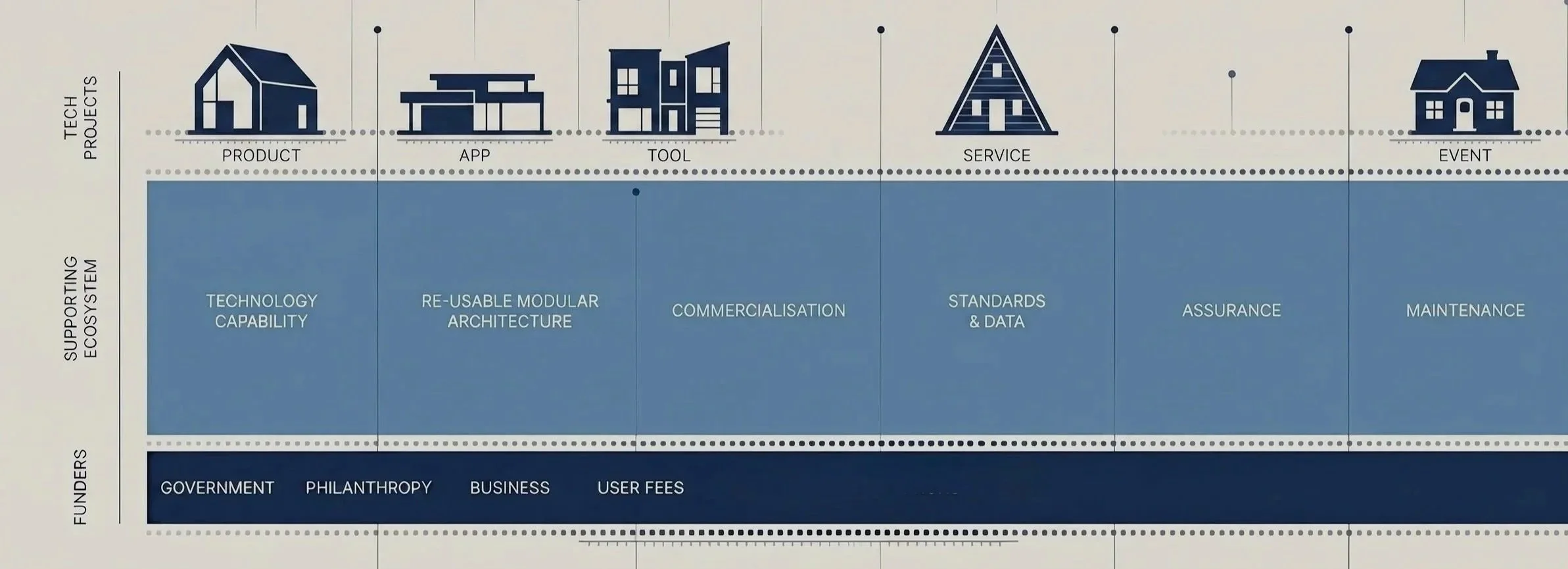
Financial Models (and other structural supports) missing from public interest tech.
Public interest technology gives us an opportunity to build services that reach far more people at dramatically lower marginal cost.
Realising that opportunity will require the non-profit sector to devote as much rigour to designing the institutions, incentives and financial models around those services as it does to designing and building the technology itself.
Today, significant gaps remain: technology capability; pathways for commercialisation and scale; the development and adoption of common data standards; investment in shared and reusable technology; and sustainable revenue models for low-cost, unbundled services. These are not peripheral concerns. They are part of the essential infrastructure of a modern, technology-enabled non-profit sector.
Without that supporting ecosystem, even excellent public interest technology will struggle to scale or endure. Individual products may be built, piloted and launched, but the foundations beneath them will remain fragile. Over time, the ecosystem itself risks becoming the single point of failure for public interest technology.
Funders, including governments, philanthropy and grant makers, should play a more deliberate role in building this enabling infrastructure, rather than funding technology projects in isolation. Non-profits, in turn, should increasingly develop technology initiatives through consortia that bring together community organisations, technologists, commercial partners and other actors with complementary capabilities.
This may also require a broader conception of what constitutes public interest investment. As purpose-driven, for-profit organisations increasingly demonstrate the capacity to develop affordable and scalable services for underserved communities, funders may begin to shift focus and evolve their grant making priorities.

In the Access to Justice Sector, past decisions will haunt future access to AI
Artificial intelligence is often framed as a tool lawyers can choose to adopt. But emerging evidence from the access-to-justice sector suggests something different:
Platform choice is emerging as the determinative factor impacting on AI adoption success.

From AI avoidance to responsible AI adoption
No safe default posture for non-profits avoiding AI
Many non-profits have struggled to justify the use of AI because of the significant number of risks they foresee. Not using AI is treated as the safe default - and is a posture far less frequently subjected to an assessment of risk.
But - there are risks on both sides of the decision. And when we put them next to one another, an important difference emerges.
The organisation is potentially accepting risks to its productivity, capability, workforce and ultimately its mission in order to avoid contributing to risks over which it frequently has much less control.
A Report from 2036

It is 2036 and justice is no longer experienced as a sequence of in-person attendances at court events. The physical elements of the justice system - registries, paper files, court rooms, sheriffs, and court clerks have largely disappeared, giving way to a digital eco-system that is accessible and user-friendly. Process, time and cost is proportionate to the value and complexity of the dispute being resolved. A glimpse into the future of justice reveals the architectural choices that underpinned transformative change and the benefits that flow from interoperability, digitally structured pathways, and carefully governed artificial intelligence.
What emerges is not a story of technological revolution, but of policy pragmatism in the face of inevitability.
Adaptation at pace.
Born-Digital Courts and Process Proportionality in Modern Justice.
Digitally native courts are beginning to operate alongside legacy institutions, enabling proportionate dispute pathways, strengthening administrative coherence, and supporting more accessible participation. Data emerging from born-digital courts established internationally reveals this approach to have substantial advantages in the design and build phases, and in the implementation and pilot phases. These include lower risk profile, especially in data migration and organisational change / resistance; expedited timelines to MVP and launch; better user-comes through process simplification; faster resolution times and lower delivery costs.
Justice sector modernisation is no longer a technology challenge. It is now a question of political ambition, and institutional design.
As the gap between public expectations and justice sector performance widens, the administration of justice will increasingly bear on both economic confidence and public trust in the decades ahead.
Institutional Design and the capacity of Modern States.
The Architecture of Trust explores why legitimacy, governance, and institutional design are becoming the hidden infrastructure of the AI era.
The Architecture of Trust (And other emerging AI design deficiencies).
Artificial intelligence will not scale on capability alone. Its success depends on trust in the organisations that build it, the outputs it produces, and the systems within which it operates.
Institutional design shapes how authority is exercised long before policy is debated. When architecture aligns legitimacy, accessibility, and accountability, public systems become easier to navigate and more resilient under strain. This essay examines how capable states approach institutional renewal — not through disruption, but through deliberate design that preserves trust while enabling adaptation.

Legitimacy & Trust
Beyond Disposal Rates: Why Distributional Analytics Will Define the Legitimacy of Digital Courts.
Historically, litigants experienced procedural fairness through visible judicial process. In digital environments, fairness is inferred from system design, from whether pathways are understandable, contestable and perceived to be impartial.
This creates a measurement problem.
Traditional KPIs can tell us how quickly matters conclude once they enter the system. They reveal far less about what happens before formal adjudication, including who never proceeds, who abandons claims, or who settles prematurely within highly structured digital flows..
Four Futures for AI and Digital Courts to 2040.
Courts are adopting AI not as a single reform program, but through a growing set of tools: guided filing, triage, translation, transcription, scheduling optimisation, decision support, and drafting assistance. Many of these tools will be invisible to court users. Collectively, they reshape how public authority is exercised: what is seen, what is prioritised, what is delayed, and what becomes decisive. This piece offers a practical taxonomy of court AI, a simple test for measuring how much authority a tool exercises in practice, and concrete governance requirements that preserve legitimacy: disclosure, contestability, auditability, and human responsibility built into workflow and procurement. The aim is not to slow adoption, but to ensure that modernisation increases capability without outsourcing accountability.
Artificial Intelligence arrives in the Courts.
With the aid of multiple scenario tools, strategic choices become clearer.
Most strategies contain a single ‘ghost scenario’ which typically assumes the future looks pretty similar to the present day. In times of uncertainty and rapid change, organisations need to consider multiple scenarios, and devise strategies that remain legitimate in many futures.
This open source tool has been developed to aid scenario planning in civil justice.

Curiosity meets Purpose.
Data Insight #26
Low-Risk, High-Throughput
Where courts show up as AI-adopters, the “content” clusters around reducing defective filings and staff touch-time via guided e-forms + rule enforcement + integration into the court’s core systems.
Data Insight #44
A2J Actors Preference Light-Touch AI
A clear pattern in the A2J-labelled datasets is the highest-scale AI-tools are frequently only lightly AI-enabled. These tools standardise intake, guide interviews, assemble documents, support outward referrals, and provide self-help content at population scale.